


Adobe Gallery Blog
Scenes in Gouache: Curator’s Thoughts of Assimilation Practices to Artistic Triumph with Otillia Engle
Established by the federal government in 1890 with the harsh objective of assimilating Native American children into broader American society, the Santa Fe Indian School began its existence under a cloud of cultural erasure. However, as assimilation practices faltered in Santa Fe during the early 20th century, the institution underwent a transformative shift by introducing an art curriculum that turned a space of confinement into a cradle of cultural preservation. By 1932, Dorothy Dunn founded The Studio, a fine-arts program, later led by Geronima Cruz Montoya, that encouraged students to draw upon their own lived experiences and innate artistic knowledge rather than conforming to rigid Western art instruction. Through this program, which ran until 1962, a generation of legendary Native artists—including Fred Kabotie (Naqavoy'ma), Allan Houser (Haozous), Andrew Tsihnahjinnie (Yazzie Bahe), Pablita Velarde (Tse Tsan), and Merina Lujan (Pop Chalee)—forged an internationally recognized painting genre that brought Indigenous visual storytelling to the global stage.
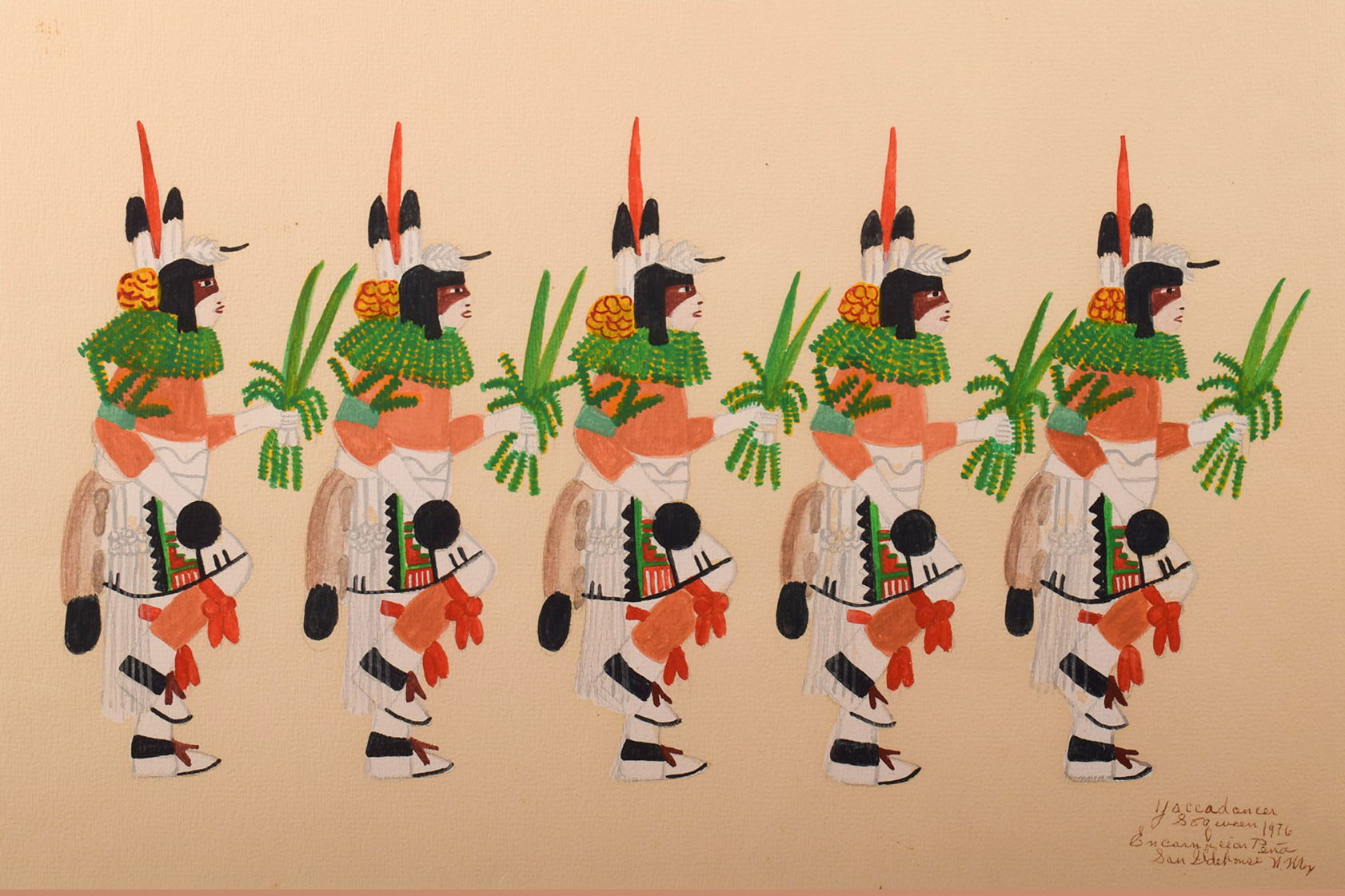
Despite these remarkable triumphs, the Flatstyle aesthetic born from The Studio, defined by its two-dimensional perspective, crisp outlines, opaque gouache or watercolors, and lack of background, sparked complex debates within Native communities. While many artists embraced the style as an authentic reflection of their heritage, others grew to view it as a creative box enforced by non-Native patrons, curators, and institutions like the Indian Market, which dictated that this specific look was the only "authentic" form of Indigenous painting. Furthermore, critics dismissively labeled the genre the "Bambi Style," a moniker fiercely rejected by Taos Pueblo artist Pop Chalee, who pointed out that Walt Disney Studios had actually visited Santa Fe, unsuccessfully tried to recruit Native painters, and purchased one of her own forest scenes. Many believed that Disney was the imitator, not the other way around.
Ultimately, the emergence of Flatstyle painting stands as a profound silver lining in the painful history of Indian boarding schools, proving that Indigenous creativity could not be suppressed even within institutions designed to erase it. By reclaiming their narrative through gouache and watercolor, these pioneering students transformed a restrictive market expectation into a launching pad for the Modern and Contemporary Native art movements we celebrate today. Their enduring resilience and artistry can be seen firsthand in Adobe Gallery’s special exhibit, Scenes in Gouache: Flatstyle Painting from the Santa Fe Indian School, which showcases masterworks by Native American masters and their contemporaries.